If you are already running sites, coordinating trades or carrying more responsibility than your job title suggests, a QBCC builder licence may be the step that lets you contract for complete building projects under your own business.
You are not starting from zero. You may have years on the tools, be running sites already or have worked your way up from carpentry into foreman and supervisor roles.
The issue is rarely whether you have worked hard enough. It is whether your qualifications and project history meet the requirements for the builder class you plan to apply for. Depending on the class and your existing qualification, QBCC may require two or four years of relevant experience, including evidence of the supervisory work you personally performed.
Builders Licence Success checks which QBCC builder class is likely to fit, then helps turn your project history, qualifications and referee details into application material QBCC can assess.
Do you plan to contract complete building projects?
A builder licence may fit if you plan to:
- contract directly with clients for complete building projects
- run renovations, new homes or other projects covered by the builder class
- coordinate and supervise several different trades
- contract and manage the complete build rather than only one trade component
- move from a supervisor or experienced tradie role into your own building business
If you only plan to quote and carry out one trade, such as carpentry, painting or waterproofing, a trade contractor licence may be the better starting point. The builder licence versus trade contractor licence guide explains the difference with examples.
You do not need to pick the QBCC class by yourself
Queensland has different builder classes, including Low Rise, Medium Rise, Open and restricted classes. Each one covers different building work and has its own qualification and experience requirements.
You do not need to arrive at BLS knowing which one to choose. Tell us about the projects you have worked on and whether you plan to quote full renovations, new homes or another type of building work. We can compare that with the available QBCC classes and explain which application is likely to fit.
The class matters because it sets the qualification and experience requirements. Confirming the likely class first reduces the risk of paying for a qualification or collecting project records for an application that does not let you contract the jobs you are planning.
What experience can help your application?
Years in construction matter, but QBCC also needs evidence of the responsibilities you carried on real projects.
That can include:
- coordinating trades and the order of work
- reading plans and dealing with site changes
- organising inspections and rectification work
- managing safety, quality, schedules or subcontractors
- communicating with clients, builders, certifiers or other project parties
- taking responsibility across several stages of a build
For example, “worked as a carpenter for eight years” gives only the job title. A stronger picture explains the types of projects, the stages you worked across, the decisions you made and who can confirm it.
You do not have to rewrite your experience in regulator language. Tell us what you actually did, and BLS can organise it into clear project records without inventing or overstating your role.
What if you have the experience but not the qualification?
An RTO may be able to recognise skills you can already prove, so you do not repeat training unnecessarily.
Through Recognition of Prior Learning (RPL), an RTO compares your evidence with the relevant training product. You may receive full or partial credit. If gaps remain, the RTO may require additional training or assessment.
The sequence matters. First identify the likely builder class and its qualification requirement. Then explore RPL or training for the actual gap. The RTO decides the qualification outcome, and QBCC decides the licence application.
Read how RPL may fit before a QBCC licence application.
Who can confirm your experience?
QBCC may require experience records and referee information for a builder application. A useful referee is not simply someone who knows you are a good worker. They need to know the projects and responsibilities you are relying on and be able to confirm them accurately.
QBCC generally expects a referee who holds a licence or qualification at the same or higher level than the licence sought. In some circumstances it may consider a supervisory or managerial referee. The applicant and referee need to confirm the experience record, and the referee must be able to verify the work claimed.
Before your application is put together, BLS checks:
- which projects each referee actually knows
- whether their licence or role matches the work and responsibilities they can genuinely confirm
- whether the dates, project details and responsibilities are consistent
- whether they understand what they may be asked to confirm
This can prevent a good work history from being weakened by the wrong referee or vague project details.
From site history to a QBCC application
- Tell us where you are now. We look at your trade, current role, qualifications, licences and the projects you have worked on.
- Explain the jobs you plan to contract. Full renovations, new homes and restricted building work can point to different QBCC classes.
- Check the likely application. We compare your situation with the relevant builder, supervisor, trade or mutual recognition option.
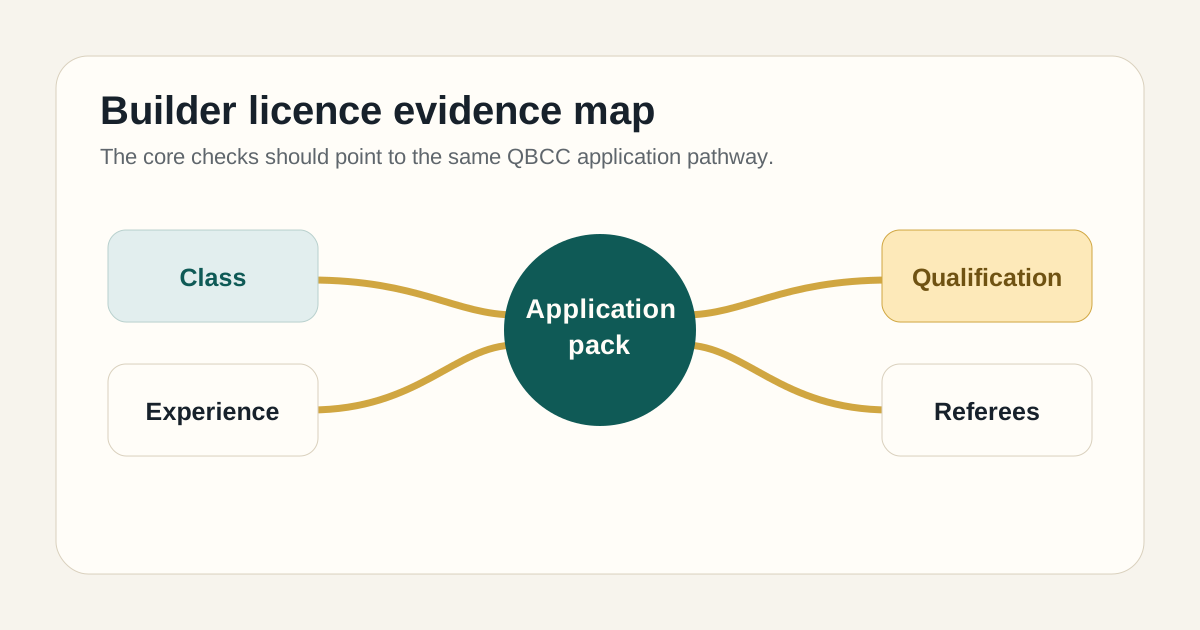
- See what is missing. We check the qualification, experience records, referees and business information required for that application.
- Prepare the paperwork. We help make the forms and supporting documents clear and consistent before lodgement.
QBCC assesses the application and makes the final decision. BLS focuses on the parts you can control: applying for the appropriate class, describing your genuine experience clearly and getting the paperwork ready to lodge.
What should you gather?
Do not wait until you have a perfect file. Start with anything you already have:
- qualification certificates and existing licences
- a basic work history or CV
- a list of projects you remember clearly
- photos, plans, schedules, permits, contracts or job records you can lawfully use
- names of builders or supervisors who know your work
- details about the renovations, homes or other building jobs you plan to contract
BLS can sort what is useful, identify what is missing and tell you what is worth chasing. You do not need a perfect file before you start.
Common problems BLS helps find early
- The applicant has bought a course before confirming which qualification QBCC needs.
- The projects show strong trade work but not enough broader builder responsibility.
- The referee cannot verify the parts of the project being claimed.
- The dates, roles or project details change between documents.
- An interstate licence may create a mutual recognition option that has not been checked.
- The person is aiming for a builder licence when a trade contractor or supervisor licence better matches how they plan to operate.
Ready to move from trade work or site supervision into your own Queensland builder licence? Check your Queensland builder application and tell BLS which projects you have run and whether you plan to contract renovations, new homes or another type of building work.
FAQ
Is being an experienced tradie enough for a builder licence?
Experience is important, but QBCC also looks at the required qualification and evidence of responsibilities relevant to the builder class. BLS helps you see what your existing background already supports and where the gaps may be.
Do I need RPL or a full course?
Not necessarily. First confirm the likely licence and required qualification. An RTO can then assess whether your experience may count through RPL and whether any gap training is needed.
What if I already hold a licence interstate?
If you are an individual with a current equivalent interstate or New Zealand licence, you may be able to apply under mutual recognition. QBCC decides equivalence and carries across applicable restrictions. The process does not apply to companies or partnerships.
Does BLS guarantee a QBCC licence?
No. QBCC makes the final decision. BLS explains the relevant application and prepares the supporting material with you.